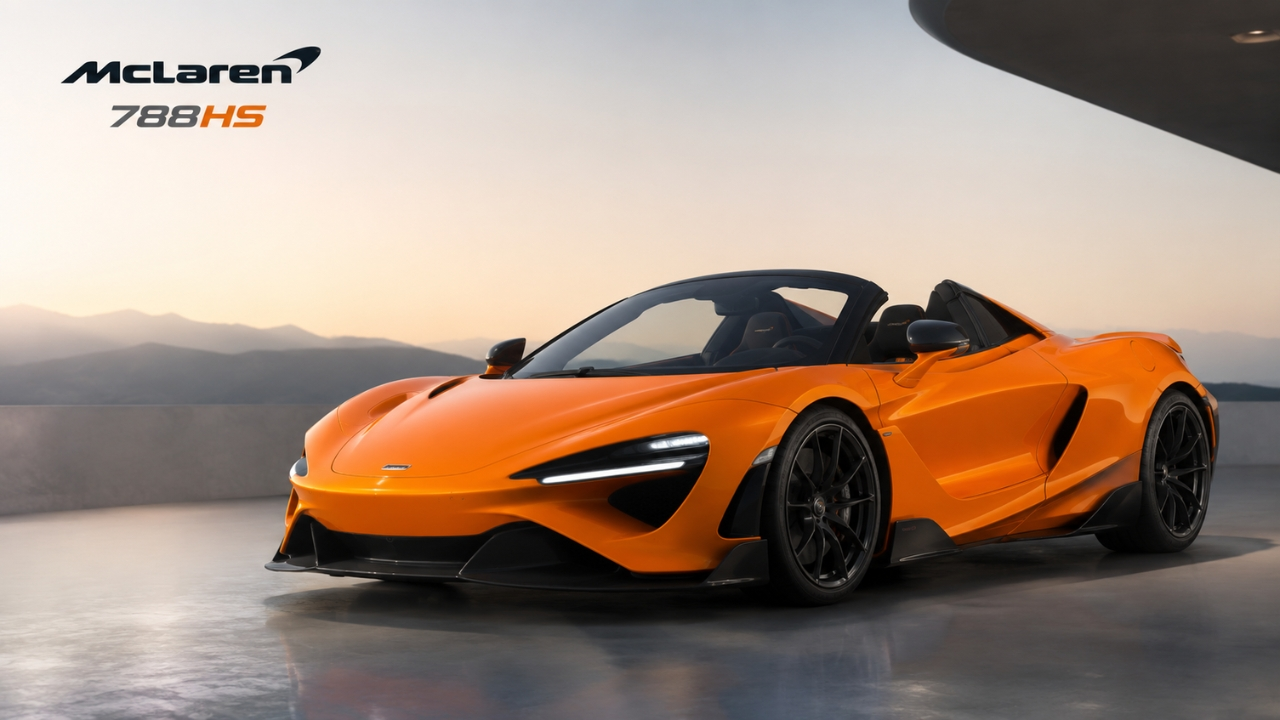
788 horsepower, 200 units worldwide, and a story that stretches back nearly a decade — meet the final chapter of McLaren’s most successful supercar lineage.
A New McLaren After a Long Silence
It has been almost two years since McLaren last revealed a genuinely new car to the world. That silence ends with the 788HS, a limited-edition high-performance coupe that marks both a milestone and a farewell. The British supercar brand has been navigating a complex period of financial restructuring and corporate merger activity, backed by £1.5 billion in fresh investment aimed at stabilising the company and pointing it toward a new strategic direction involving hybrid powertrains and expanded model ranges.
The 788HS arrives at this precise juncture — not as a teaser of what comes next, but as a definitive full stop on what came before. It is the third car ever to carry McLaren’s prestigious High Sport designation, a badge previously reserved for only the most extreme, bespoke limited runs the Woking factory has ever produced.
The End of an Iconic Platform
To understand the 788HS, you need to trace its DNA back to 2017, when McLaren launched the 720S and introduced a carbon-fibre monocoque architecture that would quietly underpin nearly a decade of development. That platform evolved into the track-focused 765LT, was refined further into the widely praised 750S, and now reaches its absolute mechanical peak in the 788HS. Each generation stripped weight, sharpened aero, and extracted more from the twin-turbocharged V8 sitting behind the driver. The 788HS is the final and most extreme expression of that journey.
McLaren will produce just 100 coupe examples and another 100 Spyder convertibles. Every single one will be a unique commission built through McLaren Special Operations, the brand’s bespoke division, meaning no two cars will leave the factory in identical specification. Buyers can choose custom liveries, clear-tinted carbon bodywork, and even personal crests embedded beneath the lacquer.
Performance Figures and Key Specifications
The name is the number: the 788HS produces 788 metric horsepower, which translates to approximately 777 brake horsepower. The sprint from 0 to 62 mph takes just 2.7 seconds, and the car tops out at 205 mph. Despite gaining significant aerodynamic bodywork over the 750S, dry weight has actually been reduced by 12 kilograms to a claimed 1,265 kg — an impressive achievement for a car with this level of additional hardware.
| Specification | McLaren 788HS | McLaren 750S | McLaren 765LT |
|---|---|---|---|
| Power Output | 788hp (777bhp) | 750hp (740bhp) | 765hp (755bhp) |
| 0–62 mph | 2.7 seconds | 2.8 seconds | 2.8 seconds |
| Top Speed | 205 mph | 206 mph | 205 mph |
| Dry Weight | 1,265 kg | 1,277 kg | 1,229 kg |
| Production Run | 200 (all variants) | Ongoing | 765 units |
Figures based on manufacturer claims. Final homologated numbers may vary by market.
Aerodynamics: Dramatic Looks With Measured Claims
The 788HS is the most visually aggressive car to emerge from the 720S generation. Up front, a bespoke splitter and enlarged air intakes reshape the nose, while a bonnet S-duct — a channel carved through the bonnet itself — redirects airflow over the cockpit. A functional roof scoop manages engine bay temperatures, though it does compromise rear visibility somewhat. The side sills carry over from the 765LT, but the rear of the car is where the engineering ambition really shows itself: a snowboard-sized rear wing replaces the original flush airbrake, a quad-exhaust system with perforated finishers adds visual drama, and the largest diffuser ever fitted to this generation of McLaren gets F1-inspired slots cut into its vanes. New forged centrelock wheels wrap around the legendary McLaren Senna braking package.
Impressively — and unusually for the supercar world — McLaren has chosen to be conservative with its downforce claims. Rather than announcing eye-catching numbers, the brand states the 788HS generates roughly 10 percent more downforce than the 765LT, and crucially, this figure was validated inside an actual Formula 1-grade wind tunnel. At a time when rivals routinely publish dramatic downforce statistics without independent verification, McLaren’s caution is a deliberate signal of engineering integrity.
Inside the Cabin and What It Costs
Step inside the 788HS and the interior is a familiar, purposeful place. The lightweight carbon seats sourced from the McLaren Senna are standard fitment, accompanied by generous use of Alcantara suede and exposed carbon fibre throughout the cabin. The architecture mirrors that of the 750S closely, which is no bad thing — it remains a driver-focused, intuitive environment that strips away anything not directly connected to the act of driving. The roof scoop does encroach on the space above and behind the driver’s head, making the cabin feel even more enclosed and focused than usual.
Pricing is expected to land somewhere in the £300,000s, though given that each car is a bespoke commission, the final figure will depend entirely on the individual specification chosen. What makes the 788HS genuinely interesting beyond the performance numbers is its place in history. It closes an era that began with the 720S in 2017, and it arrives at the precise moment McLaren is preparing to reinvent itself with electrified platforms, a potential four-door model, and a fundamentally different business strategy. For collectors, that backstory may prove to be just as valuable as the car itself.
Frequently Asked Questions
McLaren will produce 100 coupe and 100 Spider versions, for a total of 200 cars worldwide.
HS stands for High Sport, a rare designation McLaren reserves for its most exclusive limited-edition models.
No — the 0–62 mph time is identical at 2.7–2.8 seconds, as the extra aerodynamic drag offsets the additional power.
Prices are expected to start in the £300,000s, varying significantly depending on bespoke specification through McLaren Special Operations.
2027 Kia Rules Out Tasman-Based 4WD and Tiny EV1 — Here’s What the Brand Is Focused on Instead