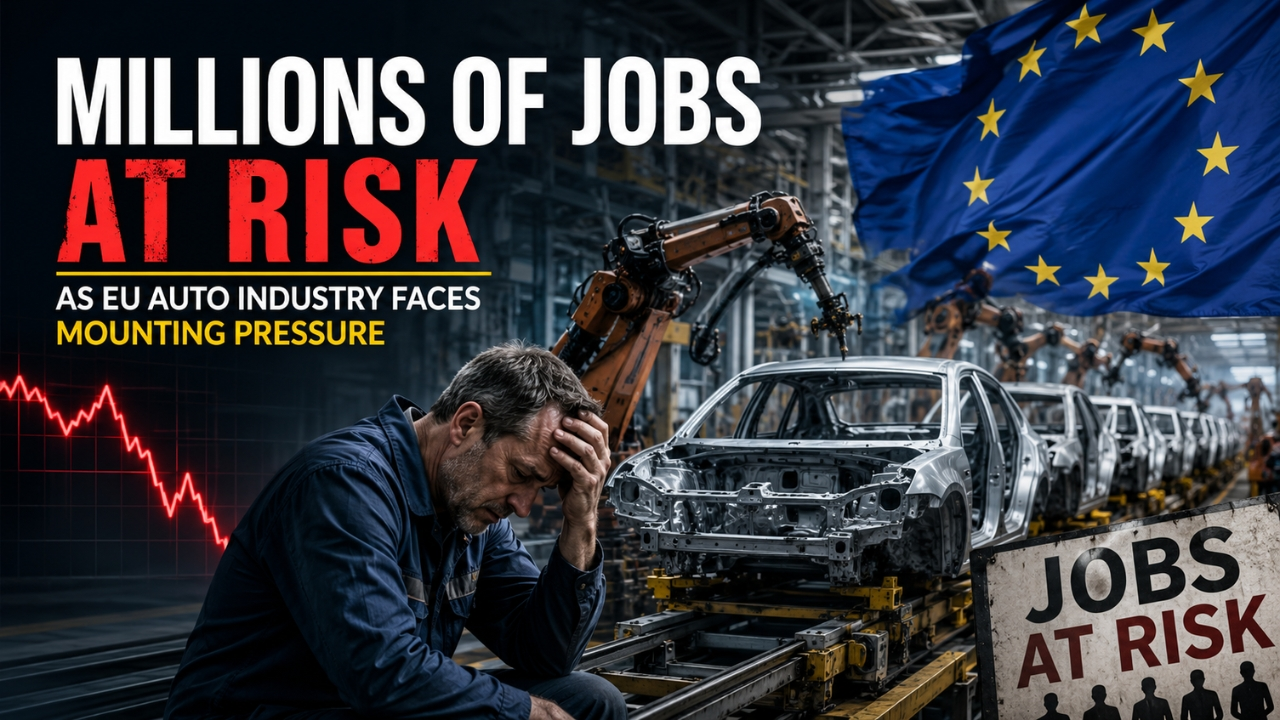
Something is quietly breaking inside Europe’s most powerful industrial engine. The continent’s automotive sector — long the backbone of manufacturing employment and regional economies — is showing deep cracks. European Commissioner for Industrial Strategy Stéphane Séjourné put it bluntly before the European Parliament in Strasbourg recently: the industry is not just struggling, it is fighting for its survival. Production lines are running below full capacity. Layoff notices are piling up at supplier factories. And the warning signs were all there, well before this moment arrived.
Chinese Competition Is No Longer a Distant Threat
What was once dismissed as a manageable rivalry has grown into something far more disruptive. Chinese automakers, backed by state subsidies and decades of accumulated industrial policy, are now shipping more vehicles into European markets than ever before. The numbers tell the story plainly — Chinese brands have captured over 15 percent of Europe’s electric and electrified vehicle market. That figure would have seemed impossible just five years ago. The problem goes beyond price undercutting. European manufacturers are dealing with a structural mismatch: they carry heavier cost burdens, face tighter regulatory timelines, and compete against rivals who have already cleared the technological hurdles of EV mass production.
Key Pressures Threatening EU Auto Competitiveness in 2026
| Pressure Area | Current Impact |
|---|---|
| Chinese EV Market Share (EU) | Over 15% of electrified vehicles |
| Supply Chain Disruption | Geopolitical instability affecting parts availability |
| Tariff Burden | Raising production and import costs for EU firms |
| Battery Manufacturing Gap | EU still scaling capacity vs. China’s established lead |
| CO₂ Compliance Costs | Significant financial burden on legacy manufacturers |
Supply Chains Are Cracking Under Geopolitical Pressure
Beyond Chinese competition, the supply chains that EU automakers depend on have grown dangerously fragile. Years of globalization created lean, highly efficient networks — but those same networks proved brittle when geopolitical tensions flared. Today, sourcing critical battery materials, semiconductors, and specialty components has become an exercise in risk management as much as logistics. Commissioner Séjourné specifically flagged weakened supply chains as one of several simultaneous pressures the industry is absorbing at once — alongside import barriers limiting EU carmakers’ access to overseas markets and a competitive disadvantage in the electric vehicle technology race. The combination is punishing.
What Brussels Is Proposing — and Why Speed Matters
The European Commission is not standing still, though the clock is ticking. An automotive package unveiled last December laid the groundwork, followed in March by proposals for an industrial accelerator intended to cover the entire automotive value chain for the first time as a unified strategy. The Commission is working toward greater flexibility in carbon dioxide emissions targets without abandoning climate goals entirely, hoping to preserve market space for European manufacturers while making secondhand electric vehicles more accessible to ordinary households. Plans to fast-track affordable small EVs and expand battery production capacity across the continent are also on the table. The push now is to get member states and the Parliament to move on proposed legislation without delay — because every month of inaction is a month where the gap widens.
Workers and Regions Cannot Wait for a Slow Recovery
What gets lost in the policy debate is the human dimension sitting directly underneath it. The automotive sector does not just employ engineers at flagship brands. It sustains a vast web of smaller suppliers, logistics firms, tooling companies, and regional economies where a single plant closure can hollow out a community for a generation. Séjourné was direct about this obligation when he addressed lawmakers, saying Europe owes it to the industry, its workforce, and the regions whose livelihoods are tied to automotive production. Stopping what he called the “vicious cycle” — where production volumes, market share, and value creation all shrink together — is the central challenge. Whether the Commission’s strategy arrives quickly enough to interrupt that cycle is the defining industrial question facing the EU right now.
FAQs
Why is Europe’s auto industry in crisis?
A mix of Chinese EV competition, rising tariffs, weak supply chains, and technology gaps is hitting manufacturers simultaneously.
How much of Europe’s EV market do Chinese brands now hold?
Chinese brands account for more than 15 percent of Europe’s electric and electrified vehicle market.
What is the EU doing to protect automakers?
The Commission is pushing an automotive strategy covering the full value chain, with flexible CO₂ rules and battery capacity expansion.
Are job losses already happening?
Yes — factories are running below capacity and the risk of mass layoffs among suppliers is actively increasing.
Germany’s Car Industry Is Facing a Jobs Crisis — And China Is Only Part of the Problem