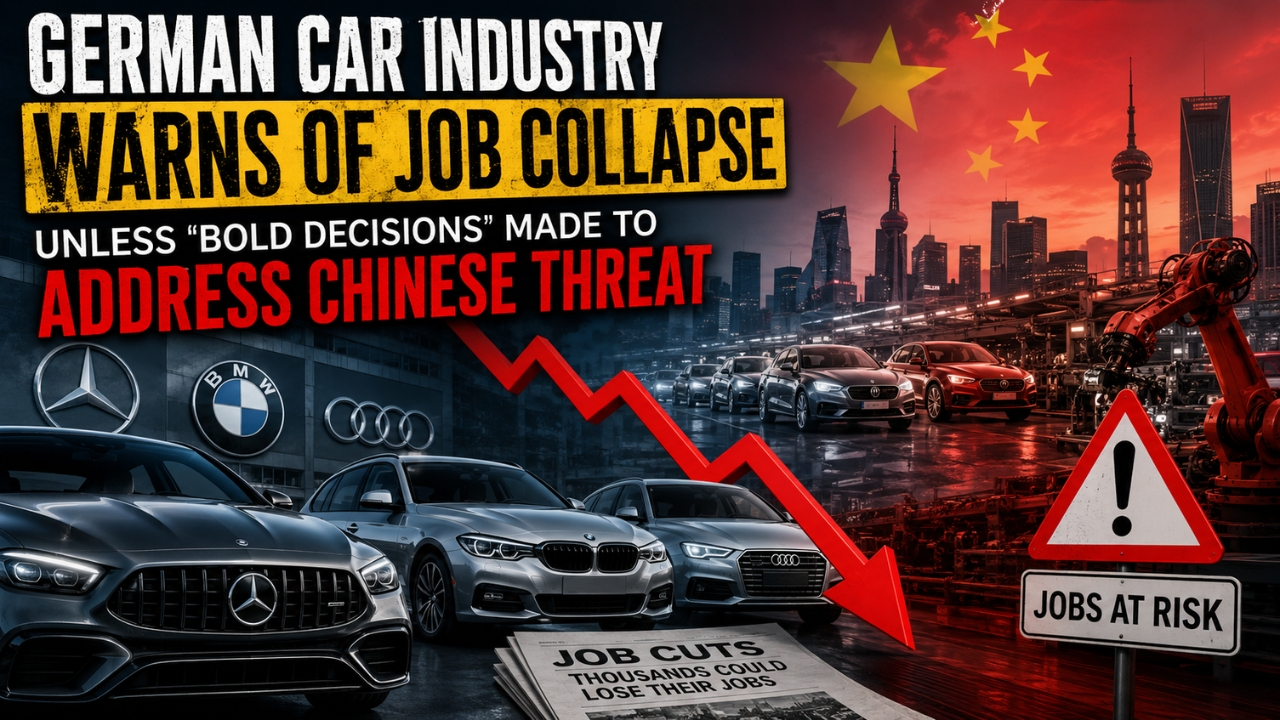
The German automotive sector, once the undisputed pride of European manufacturing, is standing at a crossroads. Industry leaders are now openly warning that without genuinely uncomfortable structural changes, the country could see its most dramatic wave of factory job losses since the post-war era. The wake-up call is no longer theoretical — it is happening on the shop floor, quarter by quarter.
Volkswagen’s 100,000-Job Plan Has Shocked the Nation
When Volkswagen put forward a proposal to cut up to 100,000 jobs by 2030 — double its earlier restructuring target — the response from workers and unions was immediate. The powerful trade union IG Metall called a day of industrial action across all major VW sites, including Emden, Zwickau, Hanover, and Kassel. Events were also planned at Porsche, Audi, and truck maker MAN. This is not a routine cost-saving exercise. VW’s CEO Oliver Blume has described the overhaul as essential to the company’s survival, acknowledging that the current business model is no longer sustainable given the pace of change in the global auto market.
The German Association of the Automotive Industry (VDA) responded with a statement that went further than most expected. Its president, Hildegard Müller, warned that “reality has overtaken political goals and approaches, increasingly jeopardising jobs,” and called on workers, businesses, and policymakers to accept “bold decisions” as the only viable path forward. Controversially, the VDA even suggested that selling some German car plants to foreign owners could be a pragmatic way to preserve employment — a statement that would have been unthinkable a decade ago.
The Numbers Behind the Crisis
The scale of deterioration in Germany’s automotive sector becomes clearer when the data is lined up side by side. What started as a cyclical slowdown is now looking increasingly structural.
| Metric | Figure | Period |
|---|---|---|
| German auto sector employment | ~725,000 | Early 2026 |
| Jobs lost in 2025 alone | ~50,000 | Full year 2025 |
| VW Group global job cuts proposed | Up to 100,000 | By 2030 |
| Combined VW/BMW/Mercedes operating profit drop | ~76% (to €1.7bn) | Q3 2025 |
| German automakers’ revenue change Q1 2026 | -4% (vs +2% global avg) | Q1 2026 |
| German share of Chinese auto market | 32% (down from 57% in 2020) | 2025 |
| VDA survey: firms planning to cut Germany investment | 72% | 2026 |
Employment in the sector has now fallen to its lowest level in 14 years. In some states, the damage is even sharper — Saarland saw automotive employment fall by nearly 11 percent in 2025 alone. Since the pre-pandemic baseline of 2019, states like North Rhine-Westphalia, Hesse, and Thuringia have each shed more than 20 percent of their automotive workforce.
China’s Rise Is Real — But Europe’s Own Demand Is Falling Too
For much of the past two years, the industry’s conversation centred on Chinese overcapacity and aggressive EV pricing. That picture is accurate but incomplete. In the first four months of 2026, EU registrations of BYD vehicles rose by over 150 percent year on year. Chinese brands as a whole crossed the 10 percent market share threshold in Europe for the first time — a figure that was 3.2 percent just a year earlier.
Yet industry analysts are now pointing to something equally troubling: European consumers are simply buying fewer cars. German manufacturers lost market share across Europe in May 2026 even as overall new car sales rose 4 percent year on year. The VDA’s Müller has noted that high unemployment and household financial pressure are dampening demand in segments where German brands traditionally excelled. This dual pressure — Chinese competition eating into export markets while domestic European demand softens — is what makes the current moment particularly difficult to navigate with conventional playbooks.
Germany’s Structural Disadvantages Are No Longer Ignorable
The crisis has thrown a harsh light on cost and regulatory conditions that German manufacturers had long managed to work around. A VDA survey found that 72 percent of automotive companies are planning to reduce investment within Germany, with many shifting spending abroad. The reasons cited include energy prices that significantly exceed those in China and the United States, high labour costs, slow permitting processes, and layers of EU and national bureaucracy that make rapid adaptation harder.
Mercedes-Benz scrapped summer bonuses and launched voluntary redundancy programmes that were taken up by 5,500 employees. BMW lowered its profit outlook and is preparing cuts of up to 10,000 roles. VDA president Müller has warned that up to 225,000 automotive jobs could disappear by 2035 if the structural conditions are not addressed — an upward revision of 35,000 from earlier estimates. She has consistently called for lower energy costs, faster regulatory decision-making, reduced tax burdens, and what she terms “technological openness” on the path to climate neutrality — meaning room for hybrids and other alternatives alongside pure battery EVs.
Can Germany’s Car Industry Find a Way Through?
The picture is bleak, but not without any light. Germany’s premium brands — Porsche, Audi, Mercedes — retain genuine global cachet that pure cost competition cannot easily erode overnight. VW is pursuing a software development partnership with Rivian to accelerate its digital vehicle capabilities. Several German manufacturers are targeting solid-state battery production in the 2028–2030 window, which could reset the competitive equation on range and charging speed. And policymakers at EU level are debating targeted EV incentives in the range of €3,000 to €6,000 to stimulate demand.
The VDA’s message, however bluntly delivered, reflects a hard truth the industry has spent several years trying to soften: the combination of Chinese industrial strategy, falling domestic demand, and Germany’s own structural cost problems has created a situation where incremental adjustments are not enough. Whether workers, unions, companies, and governments can reach the kind of consensus needed to take the painful decisions ahead — without simply offloading the cost onto those least able to bear it — is the central question of the next two to three years for one of the world’s most important manufacturing sectors.
FAQ
Q: How many jobs could Germany’s car industry lose?
The VDA warns up to 225,000 automotive jobs could go by 2035 without major structural reforms.
Q: Why are Chinese car brands outperforming German ones?
Chinese EV makers benefit from state support, lower production costs, faster software development cycles, and deep domestic market scale.
Q: Is Volkswagen really closing factories?
VW is actively considering contracting or closing several plants, including sites in Zwickau, Hanover, and Emden, as part of its restructuring plan.
Q: What is the VDA calling for?
The VDA wants lower energy costs, reduced bureaucracy, flexible EV regulations, and government incentives to stimulate car buying in Europe.
Lotus Eletre Becomes the First China-Built EV to Enter Canada Under the New 6.1% Tariff Deal