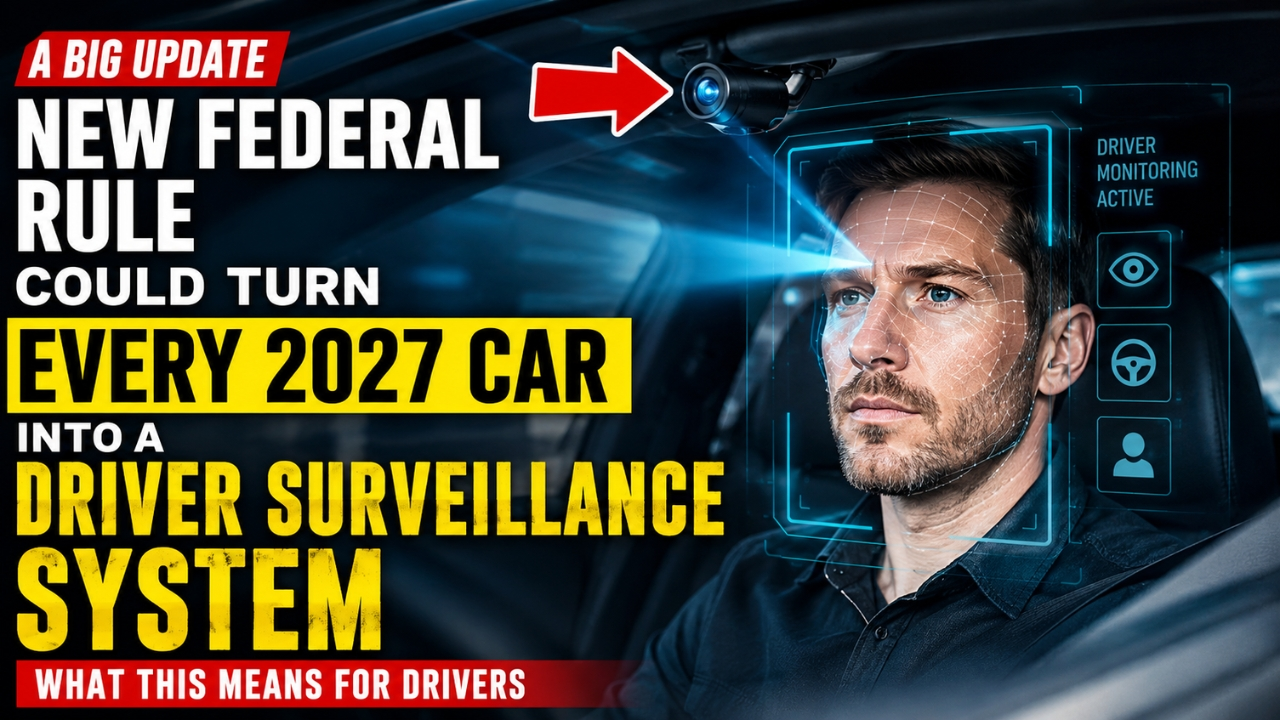
just move you from one place to another. It could be quietly studying you the entire time you’re behind the wheel — tracking your eyes, reading your head position, judging whether you seem tired or distracted, and deciding whether you’re actually fit to drive. That’s not a stretch. That’s the direction a new federal safety initiative is pushing the entire American auto industry toward, with 2027 as the proposed turning point.
What the New Federal Rule Actually Requires
The mandate comes out of a federal push to combat impaired driving — a problem that kills tens of thousands of Americans every year. Rather than relying solely on roadside enforcement, regulators want the vehicles themselves to take a more active role. The proposed requirement would make driver-monitoring systems standard equipment on all new cars sold in the United States starting with 2027 model-year vehicles.
These systems use a combination of in-cabin cameras, infrared sensors, and onboard software to track driver behavior in real time. They look at where your eyes are pointed, how often you blink, how you hold your head, and whether your attention seems compromised. If the system detects what it interprets as impairment or dangerous inattention, it may issue alerts — or, depending on how the automaker implements it, restrict how the vehicle operates.
This is not a passive safety feature sitting quietly in the background. Unlike a seatbelt reminder or a tire pressure warning, driver-monitoring technology is active from the moment the car is running.
How These Systems Compare to Other In-Car Technologies
To understand why this feels different to many drivers, it helps to look at how it stacks up against what’s already inside modern vehicles.
| Technology | When It Activates | Focuses On | Driver Override |
|---|---|---|---|
| Automatic Emergency Braking | Collision imminent | Road/obstacles | Usually yes |
| Lane Keeping Assist | Lane drift detected | Road markings | Usually yes |
| Adaptive Cruise Control | Driver-set | Vehicle spacing | Yes |
| Driver Monitoring System | Continuously, always on | The driver | Often no |
The table makes the core difference clear. Previous safety technologies respond to conditions on the road. Driver monitoring responds to the person inside the car — and it never really switches off.
The False Positive Problem Nobody Is Talking About Enough
Here is where real-world driving collides with software assumptions. Every driver naturally looks away from the forward view dozens of times per minute. Checking mirrors, glancing at navigation, watching a merging vehicle, confirming a speed sign — none of these are signs of impairment. They are just driving.
However, an algorithm reading eye movement and head position has no way of knowing context. A driver who naturally squints in bright sunlight might register differently than one who’s been awake for 20 hours, but both could trigger an alert in a system calibrated for a narrow definition of “attentive.” People with certain medical conditions, those who wear glasses, or drivers with naturally asymmetrical facial features have already raised concerns about how well these systems will handle real human variation.
The consequences of a false positive are no longer just an annoyance. If the vehicle has authority to limit operation based on its interpretation, an incorrect reading becomes a much more serious problem. Drivers would essentially be placed in a situation where they need to convince their own car that they are capable of driving it.
Where Your Data Goes After the Cameras Capture It
The monitoring itself is only the opening chapter of a longer and potentially more consequential story. Every time these systems run, they generate data — detailed behavioral records of how you drive, when you seem tired, how often you’re flagged, and how the car interprets your attention over time.
Right now, no single federal standard governs where that information must go, how long it can be stored, or who can access it. Automakers will each set their own policies, which will vary widely. Privacy advocates have already begun raising concerns about whether insurance companies could eventually access behavioral driving data to adjust premiums, or whether law enforcement could request records in the context of accident investigations.
For many drivers, that turns what was framed as a safety feature into something that looks much more like a permanent behavioral monitoring subscription — one that came bundled with the purchase price and cannot be cancelled.
What This Means for Drivers Buying a Car in 2026 and Beyond
If you are shopping for a vehicle now or planning to within the next year or two, this rule deserves a place in your decision-making. Vehicles purchased before the 2027 mandate will not be retrofitted — existing cars are not affected. But anyone buying new from 2027 onward is likely buying into a system that watches them drive, whether they chose that feature or not.
The broader question this rule forces into the open is one that goes well beyond road safety. It asks who actually controls a vehicle once it has been sold — the person who owns it, or the software stack built into it. Automakers, regulators, and privacy organizations are all going to be wrestling with that question as the deadline approaches. Drivers, meanwhile, deserve clear answers before 2027 arrives and the choice has already been made for them.
SOURCE
FAQs
Will existing cars be required to add driver monitoring systems?
No — the rule would only apply to new vehicles manufactured from the 2027 model year onward.
Can drivers turn off the driver monitoring system permanently?
In most cases, no — the system is expected to operate continuously as a built-in requirement, not an optional feature.
Can insurance companies access driver monitoring data from your vehicle?
There is currently no federal law preventing this, and policies will vary by automaker and insurer.
Does the rule apply to all vehicle types or just passenger cars?
The current federal initiative is focused on passenger vehicles, though broader application to commercial vehicles is being discussed separately.
Australia’s New Road Rules Are Now Live — Here’s What Every Driver Must Know Before They’re Fined!