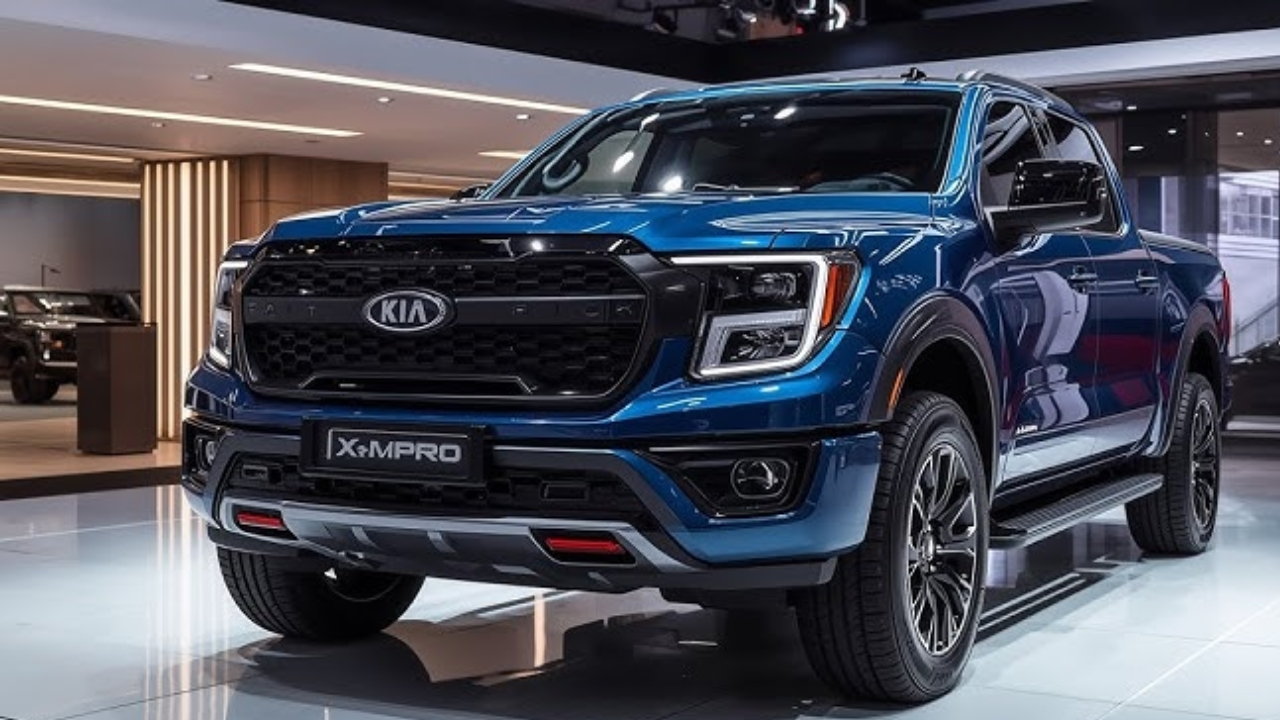
Kia has officially drawn a line under two of the most talked-about vehicles in its rumoured pipeline. A senior executive at the Korean carmaker has confirmed that neither a rugged 4WD sibling to the Kia Tasman ute nor an entry-level electric car smaller than the EV2 will be joining the brand’s lineup anytime soon. The announcement settles months of speculation and gives buyers a clearer picture of where Kia is actually headed over the next few years.
The Tasman-Based SUV That Won’t Happen
For a while, automotive enthusiasts had been quietly excited about the possibility of a Kia SUV built on the same body-on-frame platform as the Tasman ute — a vehicle that would have gone toe-to-toe with the Toyota Prado, Ford Everest, and the GWM Tank 500. Discussions had reportedly even taken place within Kia Australia at a conceptual level. But Spencer Cho, Kia’s Senior Vice President and Head of Global Business Planning, made it clear that such a project is not on the agenda. His reasoning was straightforward: the brand believes its current product range is already comprehensive enough, and the priority now is to make existing models better rather than launch entirely new ones. For buyers who were hoping to see a premium Kia take on the ladder-frame SUV segment, that door appears firmly closed — at least for now.
Why Kia Says Its Lineup Is Already “Big Enough”
Cho’s core message centred on a philosophy of depth over breadth. Rather than expanding into new vehicle categories, Kia intends to invest in refining the models it already sells. This includes sharpening the competitive edge of both its internal combustion engine vehicles and its growing electric range. It’s a calculated move that reflects what many well-established brands eventually arrive at — a point where spreading resources too thin across too many models becomes counterproductive. Kia currently offers a diverse spread of SUVs, a passenger car lineup, and an increasingly mature EV portfolio, which Cho described as covering the key bases buyers are actually shopping in today’s market.
The EV Lineup Kia Is Betting On
The electric vehicle side of the announcement drew just as much attention. There had been genuine anticipation around the idea of a Kia EV1 — a minicar-sized electric that would sit below the EV2 and potentially rival the Hyundai Inster in the urban runabout space. Kia representatives had previously floated the concept in European media interviews, which only added to the expectation. Cho addressed this directly, saying that while the brand remains open to exploring any gaps in the market, the focus is squarely on the EV models it already has in production. The current Kia electric lineup spans from the EV2 through to the EV9, covering a broad range of segments, from affordable compact SUVs to large family haulers.
| Kia EV Model | Segment | Key Market |
|---|---|---|
| EV2 | City / subcompact SUV | Europe, select markets |
| EV3 | Small SUV | Global |
| EV4 | Compact SUV / sedan | Global |
| EV5 | Mid-size SUV | China, global |
| EV6 | Crossover / performance | Global |
| EV9 | Large 3-row SUV | Global |
What This Means for Australian Buyers Specifically
For the Australian market, the implications are layered. The Kia Tasman has already made a strong impression locally since its launch, winning recognition for its well-rounded capability and value in a fiercely competitive ute segment. Buyers who were waiting to see whether a Tasman-derived 4WD would follow — creating a two-car off-road family for Kia — will now need to look elsewhere. On the electric front, the EV2 has not been confirmed for Australia at this stage, meaning local customers are primarily looking at the EV3, EV6, and EV9 as the main entry points into Kia’s battery electric vehicle range. Cho’s comments suggest that improving the real-world usability, software, and overall refinement of these models is where the brand’s energy is being directed.
Kia’s Strategy Points to a Maturing Brand
Reading between the lines of Cho’s comments, this is a brand that has moved past the phase of rapid expansion and into a more disciplined period of consolidation. Launching fewer new models but executing existing ones at a higher level is a strategy that tends to produce better results for customer satisfaction, dealer support, and long-term brand credibility. Kia’s global standing has risen sharply over the past decade, and protecting that momentum by avoiding overextension is arguably the smarter play. Whether this approach satisfies every enthusiast and potential buyer is another matter — but from a business standpoint, it reflects the kind of confidence a brand shows when it trusts what it already has in the showroom.
FAQs
Will Kia ever build a Tasman-based 4WD SUV?
There are no current plans, though Kia says it remains open to new opportunities if market demand changes.
Is the Kia EV1 still being developed?
No confirmed development is underway; Kia’s focus remains on improving its existing EV2-to-EV9 lineup.
Is the Kia EV2 coming to Australia?
Not at this stage — it has launched in Europe but has not been confirmed for the Australian market.
What Kia electric cars are available in Australia right now?
The EV3, EV6, and EV9 are the primary battery electric options currently available or confirmed for Australian buyers.
Ford Pulls Over 110,000 Mustang Vehicles Over Wiper and Drivetrain Safety Concerns